New Year’s Eve 1998
Cat PersonNew Year’s Eve 1998 is the night Ted arrives at Cynthia Krazewski’s party with Rachel Derwin-Finkel and leaves with Anna Travis. For Ted, it begins as a chance to imagine a private future with Anna and becomes a public collision between that fantasy, Rachel’s insistence on attending, and the uncertain reality of his attachments. Recalled twenty years later from a hospital stretcher, the night remains at once his most triumphant moment and the beginning of a decline he can see only in retrospect.
The imagined plan and Rachel’s counterproposal
Four days after Anna had returned to New Jersey, Ted was in Rachel’s room, getting dressed after another round of what the narration describes as pseudo-copulation, when Rachel asked what he intended to do for New Year’s Eve. He answered that he might stay home. Rachel rejected the idea: Ellen was having a party, and Rachel had already said they would go. Ted’s stated plan to spend the evening alone was thus put in doubt before he could decide what he actually wanted.
In his private reconstruction of the possibilities, however, staying home was not an empty evening. Ted imagined that Anna, unhappy about her obligation to attend Cynthia Krazewski’s party, might call him at the last minute. They would spend the evening together in his basement, watching television until midnight, then switch to the main television to see the Times Square ball drop. He pictured producing a chilled bottle of champagne as though he had just discovered it, and imagined the two of them moving from a tentative, closed-mouth kiss to more serious intimacy. In this fantasy, he would use a technique he had recently tried with Rachel, twisting Anna’s shirt around her arms to pin them above her head. The imagined sex would be so intense that Anna would remain with him for the rest of their lives. Ted regarded this as a foolproof plan, though it depended on Anna calling, on his staying home, and on the intimate future he had composed in his mind.
Rachel proposed a different arrangement: they would go to Cynthia’s party together, and she would call Anna to ask whether they could attend too. Rachel reminded Ted that their mothers had been friends and asked whether he would be pleased to see Anna. He said he would not. Nevertheless, they went exactly as Rachel suggested. The gap between Ted’s imagined evening and the one that takes shape at the party is central to the night: what he had pictured as private and controlled becomes a gathering in which Rachel and Anna are both present, and Ted cannot dictate what either of them will do.
At Cynthia Krazewski’s party
The party takes place in Trenton, New Jersey, on the last day of 1998. Rachel arrives dressed as though for battle, in a very tight little black dress and glittering high heels, with heavily sprayed hair arranged in a French twist. Ted rings the doorbell; after what seems to him a deliberately prolonged wait, Cynthia opens the door. The scene makes Rachel’s readiness conspicuous before the evening’s emotional contest has even played out.
Ted becomes very drunk. At one point the doorbell rings and the party is thrown into some confusion; Anna disappears, and Ted tries to follow her. Rachel stops him by gripping his wrist brutally. There is talk that Marco Hernandez has briefly come by but left after seeing Anna, and that he is subject to a restraining order. The guests debate whether the order is real or invented and what such an order means in practice. This commotion places an unsettled question of threat and credibility inside the celebration, while Rachel’s physical hold keeps Ted from pursuing Anna at that moment.
Midnight and the reversal
When midnight arrives, Ted kisses Rachel with his tongue and squeezes her buttocks. He discovers that he can enjoy an experience even while caring almost nothing about it; the simultaneous pleasure and detachment itself feels pleasurable. He wonders whether this means he has somehow become a Buddhist or is undergoing a psychotic episode. His response is neither straightforward romantic commitment nor simple refusal: he participates in the ritual of the midnight kiss while experiencing himself as distant from its meaning.
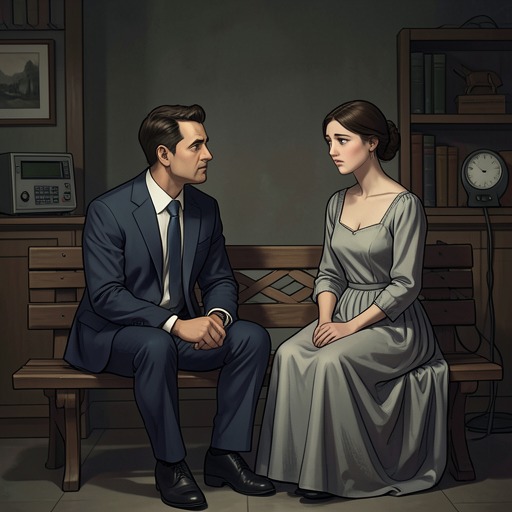
Anna sees the kiss and looks troubled. Rachel notices Anna watching and resumes kissing Ted triumphantly. Ted is left feeling, in the narration’s comparison, like a patch of grass doused with urine. The scene reverses the structure of his earlier fantasy: instead of waiting alone for Anna and initiating an intimate encounter on his own terms, he kisses Rachel in front of her, while Rachel uses the moment to assert a victory. Yet the night does not end with Ted remaining beside Rachel. After the tears and the throwing of beer—liquid only, not the glass—he leaves with Anna, despite having arrived with Rachel.
The remembered triumph and its aftermath
Ted later calls leaving with Anna the greatest and most triumphant moment of his entire life, imagining that if paradise exists, this is the feeling he would be allowed to experience there for eternity. The intensity of that retrospective description contrasts with the messy party: the drunkenness, the restraint on his wrist, the disputed order, and the kiss whose pleasure he experienced alongside indifference. His departure with Anna gives the evening its decisive turn, but it does not fulfill the particular scenario he had imagined in advance. It is not the quiet, planned encounter in Ted’s basement; it is an exit from a party where Rachel and Anna have both seen him make a choice, however complicated that choice remains.
The novel frames the memory from New York City in 2018, when Ted lies supine on a stretcher in a crowded emergency-room corridor, unable to turn his head and staring into a glaring fluorescent light. Fearing that he might be dying after a woman has thrown a full glass of water at him, he remembers Rachel warning that people die from head injuries, then acknowledges his fear and loneliness. From that exposed position, he admits that after the night he left with Anna, things went rather badly. The interval between the young Ted’s imagined eternal happiness and the older Ted’s hospital-bed assessment gives New Year’s Eve its double significance: a moment he once treated as a perfect romantic victory, and the threshold of consequences he could not then see.